
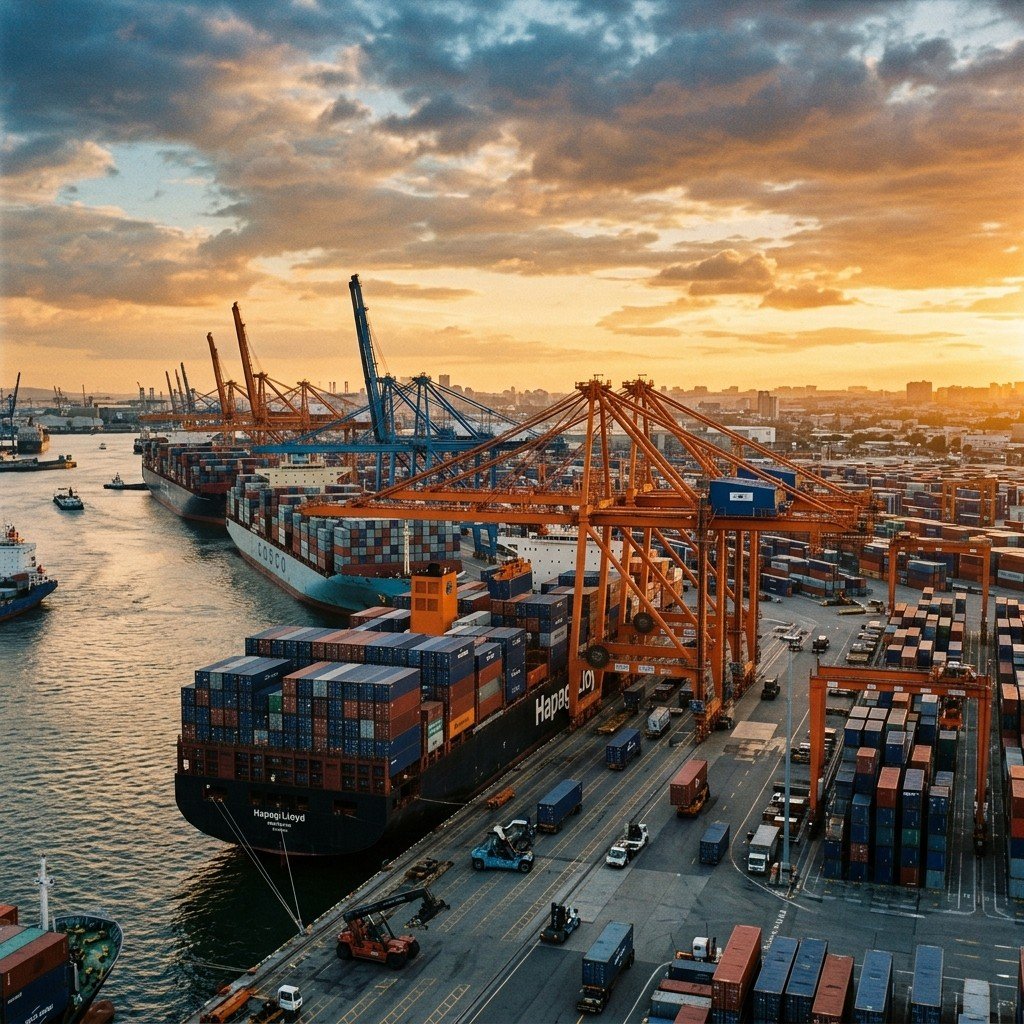
June 2026 Freight Market Update: Rates Are Surging — Here’s Your Q3 Playbook
12 يونيو 2026
If you’re importing from China right now, you already feel it. Container space is vanishing. Rates are climbing every week. And peak season — the real one, not the calendar version — started in May.
This isn’t alarmism. The Shanghai Containerized Freight Index (SCFI) has surged 70% since February. Hapag-Lloyd just slapped a $2,000 Peak Season Surcharge on Asia-Europe boxes, effective June 8. And the National Retail Federation says June import volumes are tracking 14.3% above last year.
Here’s what’s actually happening on the water, in the air, and at the ports — and the five moves that will protect your margins through Q3 2026.
TL;DR — June 2026 Freight Reality Check
- SCFI spot index hit 2,218 points — up 70% from February lows after 5 straight weekly gains
- Hapag-Lloyd PSS of $2,000/FEU on Asia-Europe takes effect June 8 — other carriers following within days
- NRF forecasts June US import volumes at 2.25M TEU, up 14.3% YoY — peak season now runs May-July, not August-October
- Transpacific spot: Shanghai→LA $2,000–$2,300/FEU, Shanghai→NY $2,800–$3,300/FEU (Red Sea premium baked in)
- Air freight costs at highest since 2022 — US supply chain stress index flashing warning signs
SCFI spot rate increase since February 2026 lows — and still climbing
The Peak Season That Showed Up Two Months Early
August through October. That’s when peak shipping season is supposed to happen. Retailers stock up for holiday sales, factories rush to meet Q4 deadlines, and rates predictably spike.
2026 ripped up that calendar.
The NRF’s June Global Port Tracker dropped a number that should make every importer sit up: 2.25 million TEU forecast for June — a 14.3% year-over-year jump. Ben Hackett, founder of Hackett Associates, put it bluntly: “The current import surge will likely last into July, with an early peak season that resembles the more recent pattern of raised volume rather than a sharp peak.”
Translation: retailers are front-loading inventory because they don’t trust what Q3 will look like. Consumer confidence is shaky. Inflation is biting. And with new tariff actions always a possibility, the smart money is getting goods into US warehouses now, not later.
The practical impact? If you haven’t booked your July and August sailings yet, you’re competing against every major retailer’s Q3 pull-forward orders — and carriers know it.
“Securing a single container slot to the US right now feels like winning the lottery — carriers are letting forwarders bid against each other for space.” — Kisun Shipping, May 2026 market report
Ocean Freight Rates: What You’ll Actually Pay Right Now
Forget the index headlines. Here’s what shippers are paying on the ground in early June 2026:
| Route | 40ft/FEU Rate | Direction | What’s Driving It |
|---|---|---|---|
| Shanghai → Los Angeles | $2,000–$2,300 | ↑ climbing weekly | Carrier blank sailings choking slot supply |
| Shanghai → New York | $2,800–$3,300 | ↑ steep premium | $800–$1,500 Red Sea re-route cost baked into all-water EC services |
| Asia → Northern Europe | $2,500–$3,100 | ↑ surging sharply | Hapag-Lloyd PSS + Cape of Good Hope adds 10–14 days transit |
| Asia → Middle East | $2,400–$3,200 | ↑ severely tight | Equipment shortages, inland congestion, emergency bunker surcharges |
One number to internalize: Asia-US East Coast rates carry an $800–$1,500 “Red Sea premium” per container that didn’t exist before 2024. That premium is now structural — it’s not going away in 2026. If you budget based on 2023 numbers, you’re undercounting by 30–50%.
The Capacity Game Carriers Are Playing — And Winning
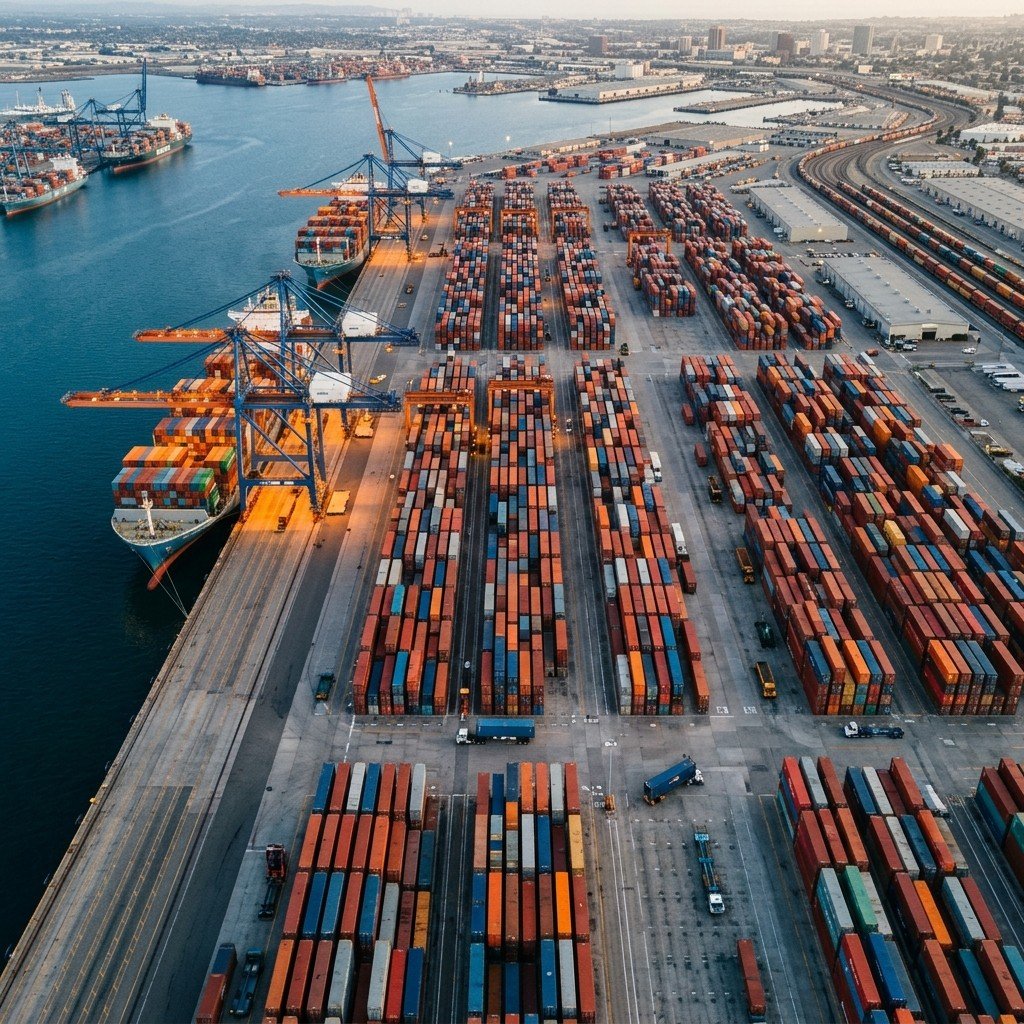
Here’s a number that should make rates drop: the container shipping order book-to-fleet ratio sits at 31.6% (Clarksons Securities). That means ships representing nearly a third of the current global fleet are on order. In a normal market, that kind of supply flood would crater rates.
But carriers have gotten very, very good at not letting the market behave normally.
Three levers they’re pulling simultaneously:
- Blank sailings at scale. Carriers pulled seven to eight major container loops out of East China in May alone. Fewer sailings = fewer slots = higher spot rates. Simple math, brutal execution.
- Slow steaming everywhere. Vessels running at 14-16 knots instead of 22-24 knots absorb excess tonnage while cutting fuel costs. It adds 3-5 days to every transpacific crossing — but carriers get paid the same (or more).
- Cape of Good Hope as the new normal. Suez Canal avoidance isn’t temporary anymore. The Cape route adds 10-14 days to every Asia-Europe sailing, effectively removing ~15% of global container capacity without scrapping a single ship.
Don’t Bet on New Ships Saving You
New container vessel deliveries will actually slow in 2026 — from 2.1 million TEU in 2025 to 1.7 million TEU this year — before surging again in 2027-2028. The capacity relief you’re hoping for isn’t arriving in time for Q3. And even when it does, carriers have proven they can manage deployed capacity more effectively than anyone predicted.
Air Freight: The Pressure Release Valve Is Getting Expensive
: The Pressure Release Valve Is Getting Expensive
When ocean freight gets tight, cargo spills into the air. That’s happening right now — and air freight rates are reflecting it.
Oxford Economics’ latest supply chain stress index hit its highest level since 2022, driven primarily by air freight costs. Rising jet fuel prices are the headline driver, but the underlying dynamic is simpler: too much time-sensitive cargo chasing too few cargo aircraft slots.
DHL’s May 2026 market update confirmed the squeeze: “Demand remains stable, with early volume peaks observed on some services. Rates are firm with an increased premium into the Mediterranean due to Gulf cargo rerouting.”
And the Baltic dry bulk shipping index is also trending up on higher bunker fuel costs — which means even the non-containerized supply chain is feeling the heat.
The Math on Air vs. Ocean Right Now
At $5–$8/kg for air freight vs. $0.50–$2.00/kg for ocean, the cost gap is still 4-6x. But if a stockout costs you $50,000 in lost sales, paying $8,000 extra for air freight on a critical restock is a rounding error. Run the inventory cost, not just the freight cost.
Your 5-Step Playbook for Q3 2026
Enough diagnosis. Here’s what to actually do:
- Book July-August space this week. Not next week. Not “when you get around to it.” Every day you wait, you’re bidding against retailers who move 100x your volume. Your forwarder needs the booking confirmed before carriers announce the next round of blank sailings.
- Spread your volume across at least two carriers. Single-carrier dependency is the #1 cause of “my shipment got rolled” emergencies. Even a 70/30 split between two carriers gives you a backup when one blanks your sailing.
- Lock a fixed rate for Q3, even if it’s above today’s spot. A 90-day rate agreement at $2,500/FEU beats whatever spot rates will look like in September if the early peak extends through summer. Negotiate with data: show your forwarder your Q3 volume forecast and ask for a commitment.
- Build 3 extra weeks of safety stock. Cape routing adds 10-14 days to Asia-Europe. Transpacific blank sailings can add 7-10 days. If your current safety stock assumes 30-day lead times, plan for 45-50 days through October.
- Watch LCL as your cost lever. While FCL spot rates bounce like a volatile stock, LCL consolidation rates have held remarkably steady at ~$110/CBM on core lanes. For shipments under 15 CBM, LCL is both cheaper and more predictable right now.
What Smart Importers Are Doing
We’re seeing our savviest clients split their orders: 70% FCL at negotiated Q3 rates for cost efficiency, 30% LCL as flexible buffer capacity. If the FCL gets rolled (unlikely but possible), the LCL shipment keeps shelves stocked. Total cost increase: ~8-12%. Peace of mind: priceless.
The Bottom Line
June 2026 is not a normal freight market. The peak arrived early, carriers have unprecedented capacity discipline, and air freight is expensive enough to hurt. But this isn’t 2021 — rates aren’t hitting $20,000 per container, and there’s still capacity available if you book proactively.
The importers who get burned are the ones waiting for rates to “come back down” before booking. The importers who sail through Q3 smoothly are the ones securing space, locking rates, and diversifying carriers — starting today.
Frequently Asked Questions
Why is peak shipping season starting so early in 2026?
Retailers are pulling inventory forward due to uncertainty around consumer spending, persistent inflation, and the risk of new tariff actions later in 2026. The NRF reports June import volumes up 14.3% YoY, compressing what used to be an August-October peak into the May-July window. The smart money is getting goods into warehouses before conditions deteriorate further.
How much are container rates from China to the USA right now?
As of June 12, 2026: Shanghai to Los Angeles FCL 40ft runs $2,000–$2,300. Shanghai to New York runs $2,800–$3,300 due to the structural Red Sea re-routing premium of $800–$1,500 per container on all-water East Coast services. These are base freight rates — all-in costs including THC, documentation, customs brokerage, and PSS surcharges typically add 20-35% on top.
Will freight rates go down later in 2026?
Don’t bet on it before Q4. The early peak is expected to last through July, and even as import volumes soften after that, carriers’ aggressive capacity management (blank sailings, slow steaming, Cape routing) will keep rates elevated. Best-case scenario: moderate softening in October-December. Worst case: PSS surcharges become permanent through year-end. Plan for rates at or above current levels through September.
Should I switch to air freight to avoid ocean delays?
Only for cargo where the cost of not having it exceeds the air freight premium. Air freight rates are also elevated — US supply chain stress from air costs is at its highest since 2022. For a typical 500kg shipment, air freight runs $2,500–$4,000 vs. $500–$1,000 by ocean LCL. The right move for most importers: book ocean earlier and buffer with 2-3 weeks of extra inventory, not switch modes entirely.
What’s the cheapest way to ship from China right now?
Sea freight LCL consolidation: rates have held steady at ~$110/CBM on major lanes, making it both the cheapest and most predictable option for shipments under 15 CBM. For larger volumes, a negotiated fixed-rate FCL contract for Q3 (even at today’s elevated levels) beats gambling on spot rates in August or September.
How do I know if my forwarder is quoting a fair rate?
Benchmark against the SCFI spot index for your lane, then add 10-20% for a forwarder’s margin on spot bookings. If a quote is 30%+ below the index, you’re being lowballed — expect “unexpected” destination charges later. If it’s 40%+ above, you’re being overcharged. The sweet spot: a forwarder who shows you the carrier rate (or SCFI reference) transparently and adds a disclosed margin.

Muhammad Fahad, Co-founder & Operations Lead, Googol Traders · Last updated: 2026-06-12