
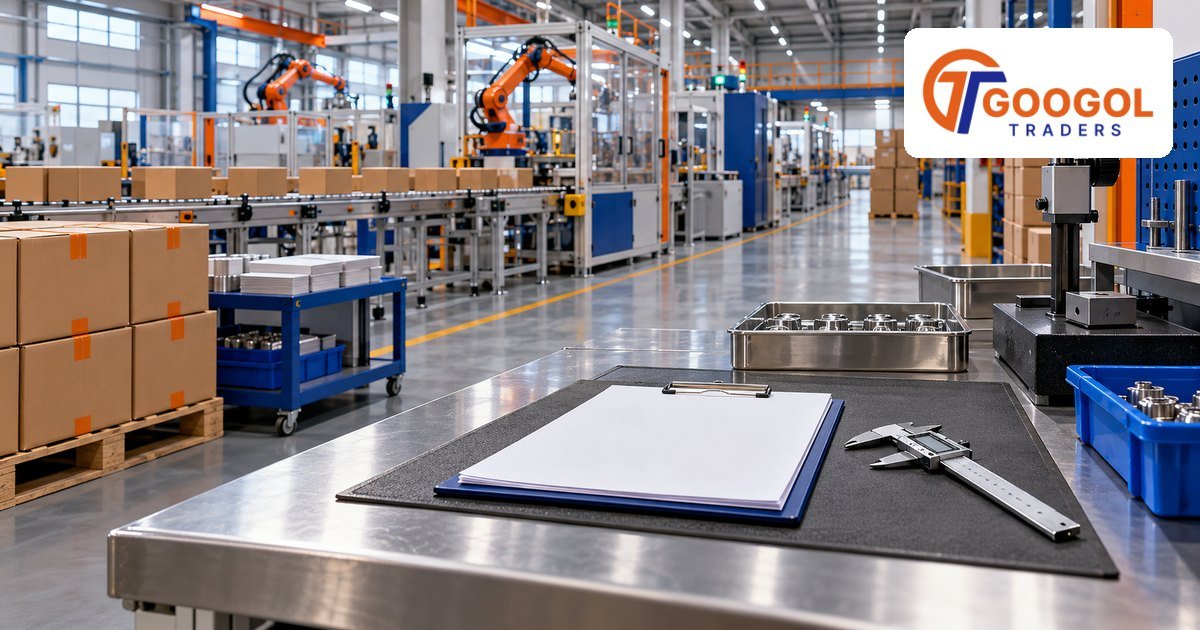
Factory Audit Checklist for Chinese Suppliers: 6 Checks Before Bulk Orders
October 28, 2026
A polished sample and a convincing sales call do not prove that a Chinese supplier can repeat the result at production scale. A factory audit is the point where you test the operation behind the promise—before your deposit, tooling and launch date are locked into the wrong production line.
TL;DR
- Audit the legal entity, production site and actual process together; a business-license check alone cannot confirm manufacturing capability.
- Use your written specification as the audit benchmark, not the supplier’s general brochure.
- Check capacity, quality controls, materials, traceability, subcontracting and worker safety before approving bulk production.
- ISO 9001 certification can be useful evidence of a quality-management system, but it is not a product-quality guarantee.
A practical factory-audit sequence: identity, site, process, quality, capacity and corrective action
What a factory audit can—and cannot—prove
A factory audit evaluates the supplier’s production environment, controls and capability at a point in time. It can help you confirm whether the named company operates at the stated site, whether the relevant equipment exists, how materials move through production and whether records support the supplier’s claims.
It cannot guarantee that every future batch will be perfect. Treat the audit as a supplier-approval gate, then use a written sample standard and a pre-shipment inspection for the order itself. This distinction matters: ISO explains that ISO 9001 is a quality-management-system standard, not a certification that an individual product is defect-free.
Before the visit: freeze the audit brief
Send the auditor a short brief before anyone visits the site. Include the legal Chinese company name, factory address, product SKU, expected process, target market, critical dimensions or materials, required certificates and the questions that would make you reject the supplier.
Do not accept a generic “factory audit” that only produces photographs. Ask for evidence tied to your product and the purchase decision:
- the production stages the factory will perform itself;
- the equipment and tooling needed for your specification;
- the quality records that will be available for review;
- the identity of any subcontractor or sister plant;
- the corrective-action deadline for each material finding.
Pro Tip
Write the audit questions before you see the factory. Otherwise a tidy showroom can dominate the visit while the unverified production line, warehouse and subcontractors receive too little attention.
The six-point China factory audit checklist
| Checkpoint | Evidence to inspect | Decision question |
|---|---|---|
| 1. Identity and site | Legal name, address, license, site signage, production and warehouse areas | Is this the entity and location that will make the goods? |
| 2. Product process | Process flow, machines, tooling, work instructions and line layout | Can the site perform the critical steps in your specification? |
| 3. Incoming materials | Approved-vendor records, material checks, batch labels and quarantine area | Can the factory identify and stop the wrong input? |
| 4. In-process and final quality | Inspection points, defect records, calibration, rework and release records | Is quality controlled during production, not only at the end? |
| 5. Capacity and planning | Lines, shifts, current load, maintenance and production schedule | Can the supplier fit your order without hiding overflow work? |
| 6. People, safety and corrective action | Training, PPE, emergency routes, worker interviews where permitted and CAPA records | Does management identify risks and close findings with evidence? |
How to inspect quality controls without getting lost
Start at the written specification and walk the product backward through the line. For each critical requirement, ask where it is measured, who records the result, what happens when it fails and whether the record can be matched to a batch or work order.
Look for controlled documents rather than impressive machines. A useful quality system has defined responsibilities, current instructions, traceable records and a way to investigate recurring defects. ISO’s guidance on externally provided processes also emphasizes approved-provider records, defined criteria and performance monitoring; use that logic when the factory outsources printing, plating, molding, testing or packing.
- Match a material label to the relevant purchase or receiving record.
- Ask to see a recent nonconformance and the evidence that the corrective action closed.
- Check whether measuring equipment has an identified calibration or verification status.
- Confirm the final inspection uses your specification, not only a generic visual check.
Common Mistake
Counting certificates as capability. A certificate may describe a management system or a test result, but it does not prove that the named factory made your sample, controls your subcontractors or can repeat the result under your order conditions.
Capacity, subcontracting and worker-safety checks
Ask the supplier to map the full production route. Some factories perform cutting and assembly in-house but outsource coating, printing, embroidery, testing or packing. Subcontracting is not automatically a failure; undisclosed subcontracting is the risk because it breaks traceability and changes who controls the specification.
Capacity should be evidence-led. Compare the claimed output with visible lines, staffing, equipment, current orders and maintenance records. Do not turn a verbal monthly number into a guaranteed lead time. Record the factory’s stated capacity as supplier-provided information and keep the commercial commitment in the purchase order.
Worker safety and labour conditions also belong in a responsible audit. The ILO’s supply-chain guidance highlights occupational safety, working time, wages, forced labour, child labour, discrimination, grievance and freedom of association as relevant areas for supplier due diligence. A basic visit should at least identify obvious safety risks, emergency access, PPE, training and management responsibility; specialist social-compliance work may require a separate audit and qualified reviewer.
Turn findings into an approval decision
Do not finish with “looks good.” Classify each finding as critical, major, minor or observation according to the risk to product, compliance, workers and shipment. Then assign an owner, evidence required, due date and recheck method.
| Result | Meaning | Next action |
|---|---|---|
| Approve | No open critical or major issue tied to the order | Freeze the specification and schedule sample or production controls |
| Approve with conditions | Risk is bounded and corrective evidence has a dated owner | Hold the relevant payment or production gate until evidence is reviewed |
| Re-audit | A major gap could change the decision | Require corrective evidence and a focused follow-up visit |
| Reject or pause | Identity, capability, safety or traceability cannot be verified | Do not release the bulk order; keep another supplier active |
Pair this checklist with our guide to verifying Chinese suppliers before you pay, then set the product standard with a sample and protect the shipment with the pre-shipment inspection guide. If you need help comparing sourcing partners, see how to choose and manage a China sourcing agent and trading companies vs factories.
Frequently Asked Questions
What should I check in a Chinese factory audit?
Check the legal entity and site, production process, incoming materials, quality controls, capacity, subcontractors, traceability, worker safety and corrective-action records. Tie each check to your product specification and record evidence rather than relying on a presentation.
Is ISO 9001 enough to verify a Chinese supplier?
No. ISO 9001 concerns a quality-management system; it does not certify that every product is defect-free or that the certificate covers the exact factory and process you will use. Verify the certificate scope, then audit the site and order controls.
Should I audit a factory before ordering samples?
For a low-value trial, you may begin with identity checks and samples. For custom tooling, regulated products, large deposits or a supplier making safety-critical goods, audit before the bulk commitment and use the findings to decide whether the sample is worth funding.
What is the difference between a factory audit and a product inspection?
A factory audit evaluates the supplier’s site, systems and capability. A product inspection evaluates specific goods or a production lot against your requirements. They answer different questions and work best together.
What if a supplier uses subcontractors?
Ask the supplier to disclose each outsourced step, identify the responsible site and explain how it controls the specification and records. Approve only when the subcontractor is acceptable for your product and the purchase terms make the responsibility clear.
Related Articles

Landed Cost of Importing from China: Formula, Checklist & Example
Build a landed-cost model for imports from China with six cost buckets, official customs-source checks and an illustrative calculation that keeps unknown charges visible.
Read More
1688 vs Alibaba: Which Platform Fits Your Imports?
1688 vs Alibaba compared for importers: price gaps, MOQs, payment protection, language and export support — and how an agent bridges the two.
Read More
How to buy from 1688 outside China: a nine-step buyer workflow
A practical nine-stage workflow for overseas buyers using 1688: product search, supplier checks, payment eligibility, China receiving, consolidation, inspection, export preparation and freight selection.
Read MoreReady to Import from China?
Get a free, all-inclusive freight quote from our team within 4 business hours.