
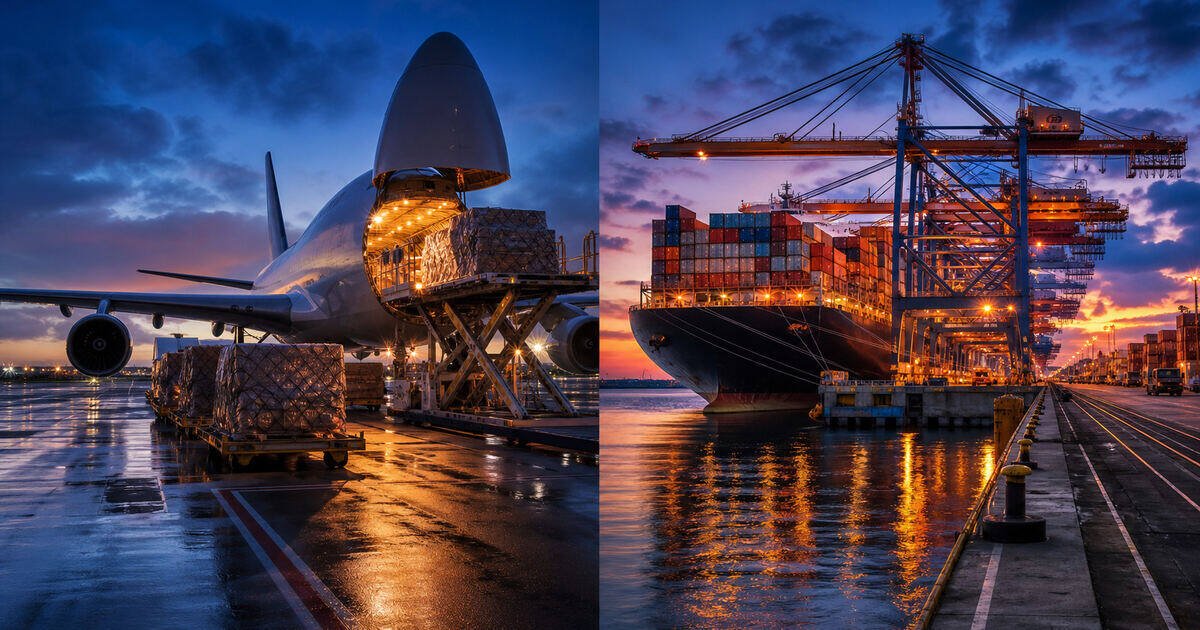
Air Freight vs Sea Freight from China to Europe: Which Is Right for Your Business?
July 27, 2026
Air and sea freight solve different problems, not the same problem at different prices. Choosing between them from China to Europe comes down to how urgently you need the goods and how that urgency compares to a 10–15x cost difference per kilogram.
TL;DR
- Sea freight costs roughly $0.30–$0.60/kg equivalent for a full container — air freight costs $3.50–$6.50/kg.
- Sea transit is 30–45 days China to Europe; air transit is 3–5 days door-to-door.
- Air freight makes sense for urgent restocks, high-value/low-weight goods, or samples — not routine bulk replenishment.
- Many importers use a mixed strategy: sea for planned bulk stock, air only to cover an unexpected stockout gap.
The Core Trade-Off: Cost vs Speed
| Factor | Sea freight | Air freight |
|---|---|---|
| Transit time | 30–45 days | 3–5 days |
| Cost basis | Per container (FCL) or per CBM (LCL) | Per kg (actual or volumetric, whichever is higher) |
| Best for | Bulk, planned restocking, low-to-mid value goods | Urgent restocks, samples, high-value/low-weight goods |
| Typical cost premium | Baseline | 10–15x sea freight per kg |
When Sea Freight Is the Right Call
For the majority of importers running planned, recurring restocks, sea freight is the default — not because air is inferior, but because the cost difference rarely justifies the time saved for non-urgent cargo. If you can forecast your inventory needs 6–8 weeks out, sea freight (FCL for bulk, LCL for smaller volumes) is almost always the better economic choice.
When Air Freight Actually Makes Sense
- Unexpected stockouts — you underforecast demand and need inventory before your next scheduled sea shipment arrives
- Product samples — evaluating a new supplier or product line where speed matters more than shipping cost on a small quantity
- High-value, low-weight goods — electronics components, jewellery, or similar items where freight cost is a small fraction of goods value
- Time-sensitive seasonal goods — missing a narrow selling window costs more than the air freight premium
Pro Tip
If air freight is only needed to bridge a gap before your next sea shipment arrives, ask your forwarder for a partial air shipment — enough stock to cover the gap, with the bulk of the order still moving by sea. This is usually far cheaper than air-freighting the entire order.
The Hidden Variable: Volumetric Weight
Air freight is priced on whichever is higher: actual weight, or volumetric weight (length × width × height in cm ÷ 6,000). Light, bulky products — padded goods, inflatables, some furniture — can cost significantly more to air freight than their actual weight suggests, sometimes eroding the speed advantage’s cost justification entirely.
Common Mistake
Requesting an air freight quote based on actual product weight without checking volumetric weight first. For bulky, lightweight products, the volumetric calculation can double or triple the billable weight compared to what you expected.
A Mixed Strategy Often Wins
Most established importers don’t pick one mode exclusively — they run sea freight as the backbone of their supply chain and reserve air freight for genuine exceptions: a stockout, a new product launch that needs speed to market, or a supplier delay that’s compressed your timeline. Treating air freight as an occasional tool rather than a routine shipping method keeps your average landed cost competitive while still giving you a fast option when you actually need one.
Sea freight builds your baseline inventory. Air freight fixes the mistakes in your forecast.
Frequently Asked Questions
Is air freight or sea freight better for shipping from China to Europe?
Sea freight is better for planned, cost-sensitive bulk shipments; air freight is better for urgent restocks, samples, or high-value/low-weight goods. Most importers use both — sea as the default, air for exceptions.
How much more expensive is air freight than sea freight?
Air freight typically costs 10–15 times more per kilogram than sea freight, though the gap narrows for very small shipments where sea freight’s minimum charges apply.
How much faster is air freight than sea freight to Europe?
Air freight typically takes 3–5 days door-to-door versus 30–45 days for sea freight, including customs clearance and last-mile delivery time on both ends.
Related Articles
ChatGPT Is Quietly Making Air Freight More Expensive — Here’s Why
AI data-center hardware pushed Asia–US air load factors to ~90% and rates up 38–41% YoY in 2026. What GPU/servers demand means for your China air shipments.
Read More
China to Europe Shipping Times: What to Expect for Air, Sea and Rail Freight
Realistic China-to-UK shipping timelines for sea, rail, and air freight, including factory production and customs clearance time.
Read More
China to Europe Shipping: Air, Sea & Rail Freight Compared
Compare air, sea, and rail freight from China to the UK on cost, speed, and use case, with a practical decision framework.
Read MoreReady to Import from China?
Get a free, all-inclusive freight quote from our team within 4 business hours.