
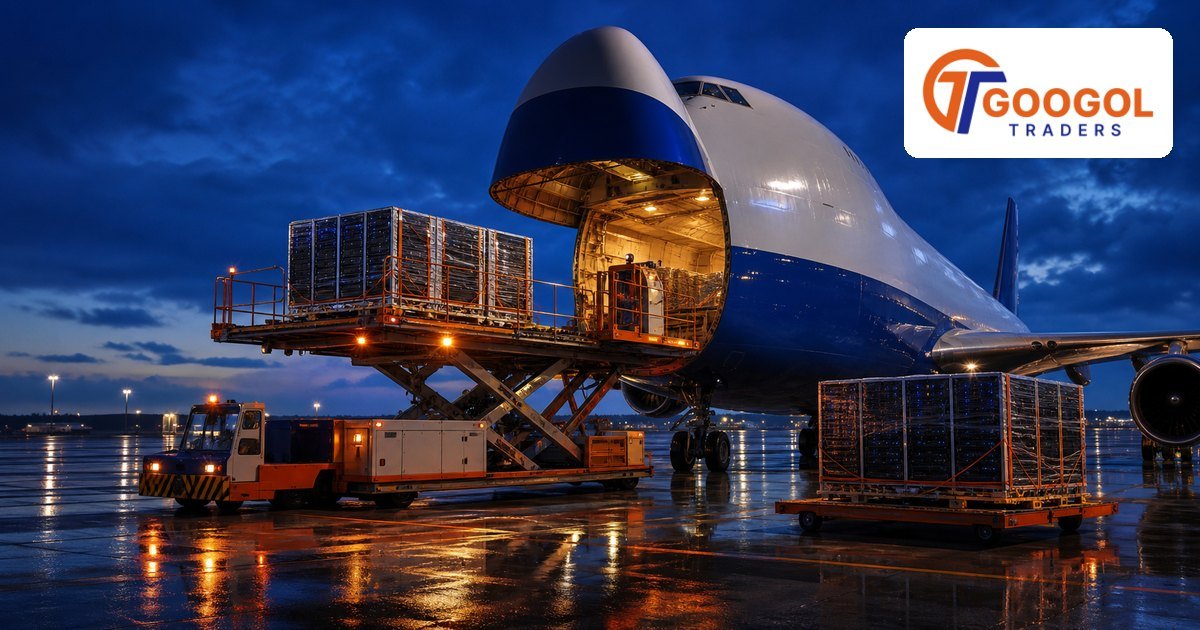
ChatGPT Is Quietly Making Air Freight More Expensive — Here’s Why
August 24, 2026
Every ChatGPT query, every AI image generation, every data center going live in Virginia or Texas starts with hardware that almost entirely ships by air from Asia. In 2026, that demand is reshaping air cargo — pushing up load factors, rates and competition for space on the exact lanes e-commerce sellers used to dominate. Here’s what it means for your shipments from China.
TL;DR
- Global air cargo rates rose 38–41% year-on-year in mid-2026, driven largely by AI/semiconductor hardware (Xeneta data).
- Asia–US load factors have hit ~90% as AI shipments replace e-commerce as the primary capacity driver.
- China–US air rates climbed ~46% year-on-year to about $5.86/kg by May 2026; Taiwan–US hit $7.02/kg.
- Non-AI shippers feel it as: higher rates, tighter space, and premium pricing for guaranteed uplift — book earlier and consider sea-air or consolidation.
Year-on-year increase in China → US air cargo rates by May 2026 (Xeneta)
Why AI Hardware Moves by Air
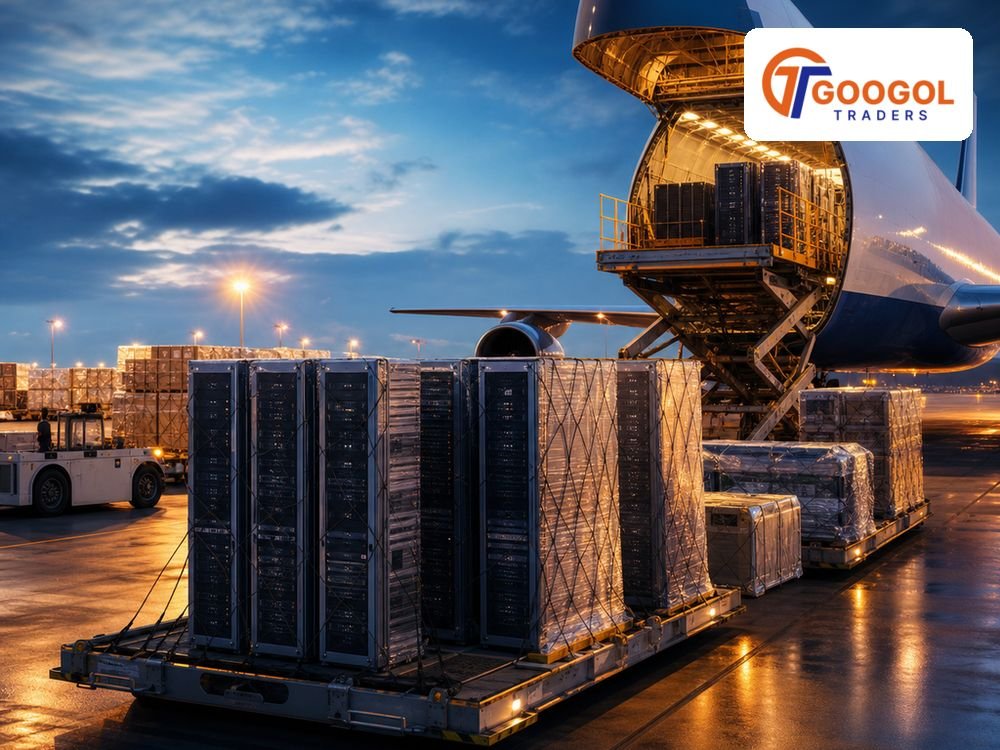
AI data centers are built on a supply chain that is small, valuable and urgent — the exact profile of air freight. GPUs and server boards are compact but extremely high-value. Fully outfitted server racks can cost close to $4 million each and, once crated, consume serious freighter volume. Transformers and chillers are oversized project cargo. Backup batteries are dangerous goods with their own handling rules. When a data center’s opening date slips, the cost of delay dwarfs the freight bill — so the hardware flies.
The scale is new. High-tech airfreight imports into the US rose 57% year-on-year in Q1 2026 (roughly 157,000 additional tonnes), with Southeast Asia and Taiwan leading. Industry forwarders report Asia–US load factors around 90% — near-record territory — with AI and semiconductor shipments displacing e-commerce as the primary demand driver.
What Happens When AI Outbids Everyone Else
Air freight capacity is finite: freighter fleets, plus belly space in passenger aircraft. When a new, price-insensitive demand source enters the market, it doesn’t add capacity — it takes it. The result in 2026:
| Market effect | Who feels it | What it looks like |
|---|---|---|
| Rate inflation | All Asia–US/Asia–EU air shippers | Global spot rates +38–41% YoY; China–US ~$5.86/kg, Taiwan–US $7.02/kg (May 2026) |
| Space scarcity | General cargo, perishables, restock shipments | ~90% load factors; “space confirmed” becomes the exception, not the rule |
| Two-tier market | Non-premium shippers | Standard-rate cargo displaced onto indirect routings via hubs — adding days and handling |
| E-commerce retreat | Temu/Shein-model sellers | EU de minimis suspension cut China–Europe e-com air volumes double digits; capacity reallocated to AI lanes |
Common Mistake
Booking air freight at “standard rates” during a capacity crunch and expecting direct service. On tight lanes, standard-rate cargo is the first to be displaced to indirect routings through hubs — your “3–5 day” air shipment becomes 7–10 days with extra handling touchpoints. If speed matters, pay for the premium product or don’t ship by air.
The China Connection: Why Shenzhen and Hong Kong Feel It Most
China’s Pearl River Delta — Shenzhen, Guangzhou, Hong Kong — is the world’s densest electronics manufacturing cluster, and it’s where AI hardware meets air capacity. GPUs, server boards and networking gear flow out of the same airports that e-commerce sellers use. When AI demand surges, the competition for uplift out of HKG/SZX is direct and immediate.
For our clients this shows up concretely: air quotes from Shenzhen that were valid last quarter now carry premium space allocations, and “next flight out” products command significant premiums over standard airport-to-airport. Meanwhile sea-air combinations via the Gulf or Southeast Asia have returned as a genuine middle option for time-sensitive but not urgent cargo.
Practical Options for Importers Who Don’t Ship GPUs
- Book earlier. In a 90% load-factor market, space is allocated days or weeks ahead. Treat air bookings like peak-season sea bookings.
- Split urgent vs deferrable. Air only the SKUs that genuinely need speed; consolidate the rest into sea LCL. A 90/10 split often beats 100% air on both cost and total delivery time.
- Consider sea-air routings. Ocean to Dubai or Southeast Asia, air on the final leg — historically 40–60% of pure-air cost with roughly half the transit time of all-water.
- Use consolidation. Our Shenzhen and Yiwu warehouses consolidate multi-supplier cargo into fewer, heavier air shipments — better rates per kg and fewer handling touchpoints.
- Get the all-in rate in writing. Fuel surcharges are running 20–30% of all-in air rates on long-haul lanes. Compare all-in numbers, never base rates.
Pro Tip
Chargeable air weight is the greater of actual vs volumetric weight (length × width × height in cm ÷ 6000). Repacking cartons down even 2cm per side on a 200 kg shipment can drop chargeable weight enough to pay for professional consolidation. Ask for a volumetric check before booking.
Will Air Freight Stay Expensive?
Xeneta’s 2026 outlook expects demand and capacity growth to roughly balance (2–3% each) — meaning rates stay elevated but probably stop climbing at 2026’s extraordinary pace. AI infrastructure spending shows no sign of slowing, and every new data center is a recurring demand event, not a one-off. Our planning assumption: air remains a premium, capacity-constrained product through at least 2027. Build lead times and budgets accordingly.
How Googol Traders Handles Air Freight in a Tight Market
We quote standard and express air products with all-in rates (fuel and security surcharges included), run volumetric checks before booking, consolidate multi-supplier cargo at our Shenzhen and Yiwu warehouses, and offer sea-air routings when pure air doesn’t justify its premium. For AI-adjacent shippers we handle high-value cargo documentation and dangerous goods like lithium batteries through compliant channels.
Frequently Asked Questions
Why is air freight from China so expensive in 2026?
AI data-center hardware — GPUs, servers, cooling equipment — has become air cargo’s largest new demand source, pushing Asia–US load factors to about 90% and rates up 38–41% year-on-year by mid-2026. China–US rates reached roughly $5.86/kg, up 46% year-on-year. Price-insensitive AI shippers outbid general cargo for limited freighter and belly capacity.
Does the AI boom really affect normal cargo shipments?
Yes. Air capacity is shared, so when AI hardware takes more space, everything else competes for less. General cargo faces higher rates, tighter booking windows, and displacement onto slower indirect routings unless it pays premium prices for guaranteed uplift.
How can I save money on air freight from China right now?
Book 1–2 weeks ahead, consolidate multi-supplier cargo into fewer heavier shipments, run volumetric-weight checks to avoid paying for air, split urgent vs deferrable SKUs, and compare sea-air routings via the Gulf or Southeast Asia — often 40–60% cheaper than pure air with about half of all-water transit time.
What is sea-air shipping and when does it make sense?
Sea-air moves cargo by ocean to an intermediate hub (commonly Dubai or a Southeast Asian port), then by air for the final leg. It typically costs 40–60% less than all-air and delivers in roughly half the time of all-water. It suits time-sensitive-but-not-urgent cargo in the 200 kg to several-tonne range.
How long does air freight from China to the US take?
Airport-to-airport transit is typically 1–3 days on direct services; door-to-door with clearance and delivery usually runs 5–8 days. In the tight 2026 capacity market, standard-rate cargo may be routed indirectly through hubs, adding several days — confirm the routing before booking.
A practical decision framework for your next China air shipment
AI-linked demand is a market signal, not a reason to move every SKU by air. Choose the service around the consequence of delay, the cargo’s handling profile and the certainty you need—not around a headline rate from a different lane.
| Shipment situation | First option to evaluate | Check before booking | Decision trigger |
|---|---|---|---|
| A stockout would stop sales or a launch | Air for the critical SKUs only | Confirmed uplift, routing, clearance documents and delivery hand-off | Use air only while the cost of delay is higher than the premium |
| Some units are urgent, the remainder is replenishment | Split the shipment by urgency | SKU-level quantities, carton dimensions and the date each group is needed | Keep deferrable inventory out of the premium service |
| Cargo is bulky, low-value or not time-critical | Compare sea LCL/FCL with air | Packed dimensions, consolidation cut-off, destination handling and total landed scope | Prefer the mode that protects margin after all charges, not the lowest base rate |
| Batteries, regulated or fragile technology | Specialist acceptance review before selecting a mode | Classification, packing, declarations and airline/route acceptance | Do not promise uplift until the carrier accepts the cargo |
Run this check before asking for a quote
- Separate “must arrive by” SKUs from items that can wait.
- Send packed length, width, height and actual weight for every carton—not product-only dimensions.
- Ask for the chargeable-weight rule: chargeable weight = the greater of actual weight and volumetric weight; volumetric weight is based on packed dimensions and the carrier’s stated divisor and rounding rules.
- Request the routing, uplift condition, transit definition and destination charges in writing.
- Recheck the choice if the booking date, carton count, destination or cargo classification changes.
Illustrative worksheet, not a freight quotation: calculate volumetric weight from the packed carton dimensions using the carrier’s divisor, compare it with actual weight, then ask the forwarder to confirm the billable result. Do not infer a final price from this formula.
Margin check
Use the air option for the units whose delay has a measurable business consequence. For the rest, compare a consolidated ocean option rather than assuming that one mode must serve the whole purchase order.
For the slower-mode comparison, see LCL vs FCL shipping from China to the USA. Sellers sending inventory to fulfillment centers can also review the FBA preparation and labeling guide. Saudi-bound buyers should use the China-to-Saudi shipping guide and the Saudi import step-by-step guide for the destination workflow.
Sources and update note: Market figures in this article were checked against Xeneta, Air Cargo News and IATA on 2026-08-24. Rates, capacity and routings are volatile; recheck the lane-specific quote and market evidence by 2026-08-31 before publication.
Related Articles

China to Europe Shipping Times: What to Expect for Air, Sea and Rail Freight
Realistic China-to-UK shipping timelines for sea, rail, and air freight, including factory production and customs clearance time.
Read More
China to Europe Shipping: Air, Sea & Rail Freight Compared
Compare air, sea, and rail freight from China to the UK on cost, speed, and use case, with a practical decision framework.
Read More
Door-to-Door vs Port-to-Port: Which China to Europe Shipping Option Saves You Money?
Compare door-to-door and port-to-port shipping from China to the UK to see which actually costs less once every fee is counted.
Read MoreReady to Import from China?
Get a free, all-inclusive freight quote from our team within 4 business hours.